
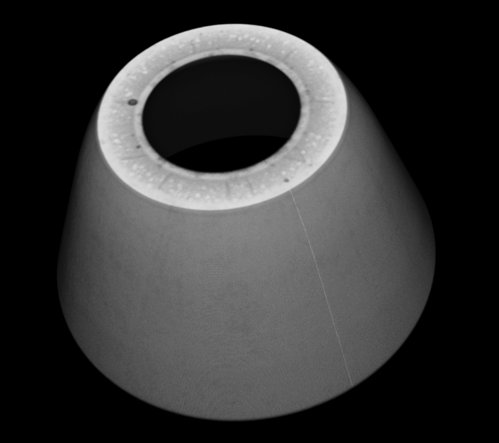
BliXray is offering its BLCT-LINACLAB linear-accelerator CT system to the munitions, propellant and rocket-motor plants now being built or expanded across Europe, giving NDT departments a way to inspect thick, dense energetic assemblies in one piece.
With accelerator energies of 2, 4, 6 or 9 MeV, the system penetrates up to 380 mm of steel, and its scanning envelope of up to 2.6 m in height accommodates complete motor cases, pressed charges and warhead sections without sectioning or sampling.
A new generation of plants, an old inspection requirement
Europe is adding energetics capacity at a pace not seen in decades: new powder and propellant plants in Germany and Poland, a chain of new energetics factories in the UK, and ammunition works in the Baltic states are all moving from planning into equipment procurement. Every one of them inherits the same non-negotiable inspection step. Cast or pressed energetic material must be verified for voids, cracks, inclusions and separation from the case before it is accepted, and the wall thicknesses, densities and steel casings involved place these parts well outside the reach of CT with conventional X-ray tubes.
“The question we hear from new plants is not whether to inspect, but how to get a complete volumetric picture of a part that a conventional 450 kV X-ray source simply cannot see through,” says Adrian de Riz, BliXray. “That is the gap the LINACLAB closes.”
Penetration beyond conventional X-ray sources
The BLCT-LINACLAB uses an electron linear accelerator in place of a conventional X-ray tube. Its four energy steps – 2, 4, 6 and 9 MeV – correspond to stated steel penetration of 200, 250, 280 and 380 mm, and the energy can be stepped down for lighter parts on the same machine. For the densest assemblies, the system runs its high-energy line detector in fan-beam mode: pixel pitch of 0.2 or 0.4 mm over a 614 or 820 mm detector length, 16-bit digitisation, and an adjustable post-collimator from 0.15 to 5 mm that rejects scatter before it reaches the detector. That combination is what preserves contrast in the low-density interior of a heavily cased part, where cone-beam scatter would otherwise dominate.
Spatial and density resolution are stated for the system and are sufficient to separate slag, porosity and inclusions in thick sections; BliXray quotes the exact values on request, together with the test conditions behind them.
An envelope sized for the whole part
Most CT systems top out well below one metre of scan height. The BLCT-LINACLAB accepts parts up to 2700 × 1400 mm on its manipulator and scans volumes of up to ø720 × 2600 mm in cone-beam mode or ø1250 × 2300 mm in fan-beam mode. In practice that means a full-length motor case, a complete pressed charge or an assembled warhead section is scanned as one object, in one coordinate system, rather than as a series of sections that later have to be reconciled.
What that means for a plant in the equipment phase
For a plant specifying inspection equipment before series production, three parameters decide whether a high-energy system fits: the densest path through the part, which sets the accelerator energy; the largest part that has to be scanned whole, which sets the envelope; and the smallest feature that must be detected, which sets the detector and collimation. “We run customer parts against those three points before proposing a configuration, and we do it early, because the shielding and building requirements of a MeV system belong in the plant design, not in a retrofit,” adds de Riz. This capability underpins BliXray’s work in aerospace and defence.
Test scans and site planning
BliXray offers test scans of customer parts on the BLCT-LINACLAB and supports site and shielding planning for new installations. Contact Adrian de Riz, BliXray, a.deriz@blix-ray.de – www.blix-ray.de.
About BliXray — BliXray designs and supplies industrial computed-tomography and X-ray inspection systems for non-destructive testing, from laboratory and desktop CT to inline and high-energy LINAC systems. Based in Hannover, Germany. www.blix-ray.de