
News ·
Inline 3D CT measures electrode overhang on every battery cell
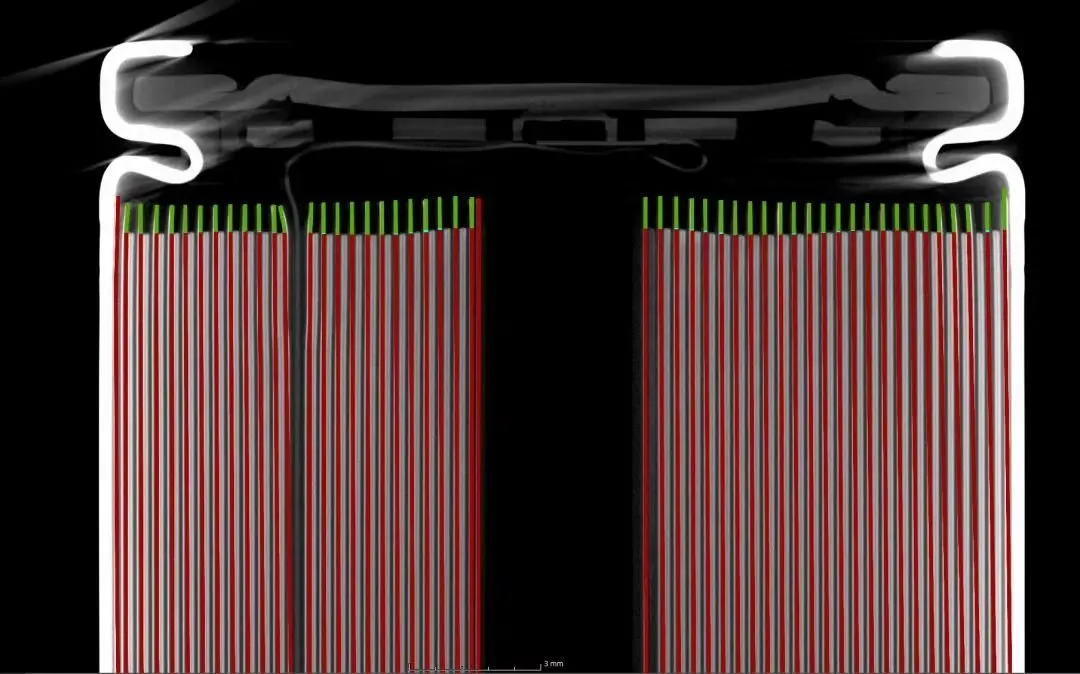
BliXray brings three-dimensional electrode inspection onto the battery production line. The BLCT-GAPRO inline gantry CT scans all four corners of a prismatic cell, measures the anode overhang automatically and returns a GO or NOGO decision for every cell at up to 36 parts per minute.
The anode overhang is one of the features that decide whether a lithium-ion cell is safe. Where the anode edge does not cover the cathode, lithium can plate out during charging. Every cell maker checks the feature; the question is how reliably it can be checked on 100 per cent of production.
2D X-ray flattens the stack, 3D CT separates it
In a 2D X-ray image the dozens of electrode layers of a prismatic cell lie on top of each other. At the corners, where the overhang has to be measured, the anode and cathode edges overlap in the projection. A real fault can hide behind a neighbouring layer, and a sound stack can throw a shadow that looks like a fault. Both errors cost money: missed faults ship, false rejects scrap good cells.
Computed tomography reconstructs each layer in three dimensions. Laboratory CT has always shown the overhang clearly, but a full scan of a cell takes far too long for a production line. The BLCT-GAPRO closes that gap with a scan strategy built for the line.
A corner scan at line speed
Instead of reconstructing the whole cell, the BLCT-GAPRO scans only the regions where overhang faults occur: a diagonal corner scan for the anode–cathode overhang at the four corners, and an edge scan for folded and crinkled electrode edges. A corner scan takes 4 to 8 seconds for two to six corners, with a scan area of 64 × 64 mm per corner and an analysis area of 8 × 8 mm. Resolution is 20 µm at a measurement accuracy of 40 µm.
The gantry rotates the source and detector around the cell while the cell itself stays still, so it can be scanned as it lies on the conveyor. The system is modular: two or four gantry rings are combined to match the cadence of the line, up to 36 parts per minute depending on cell thickness and the number of corners inspected. Reconstruction starts while the scan is still running.
“A cell maker does not need another picture to interpret; the line needs a decision for every cell,” says Adrian de Riz, Managing Director, BliXray Technologies GmbH. “The BLCT-GAPRO measures each corner in 3D and hands the line a GO or NOGO, cell by cell.”
From the measurement to the decision
Material handling, image capture and reconstruction run automatically. An AI-based image enhancement sharpens the electrode edges on which the measurement depends; an overhang recognition function turns the volume into a measured distance at each corner. Every cell is classified as GO or NOGO and reported automatically, and the result is fed back to the stacking and pressing steps upstream. The defect types checked – overhang, folded edges, foreign objects, crinkles – are configured per cell design.
Prismatic cells up to 300 × 140 mm and 65 mm high are handled; a long-cell variant takes cells up to 600 × 110 mm. The detection module sits on a granite frame, and the lead cabinet is CE-certified with a safety lock.
Test scans of your cells
BliXray offers test scans of customer cells on an inline gantry CT, with an evaluation of overhang, alignment and folded edges on your own samples. Contact Adrian de Riz, Managing Director, BliXray Technologies GmbH, a.deriz@blix-ray.de, +49 1578 0477753 – www.blix-ray.de.
About BliXray – BliXray Technologies GmbH, Hannover, designs and builds industrial CT systems and X-ray safety cabinets. Manufacturers in defence, aerospace and research use BliXray CT to inspect safety-critical parts without destroying them. BliXray cabinets and containers house X-ray sources up to 300 kV at a protection level of 0.5 µSv/h.