
News ·
BliXray extends whole-part CT to long composite aerostructures
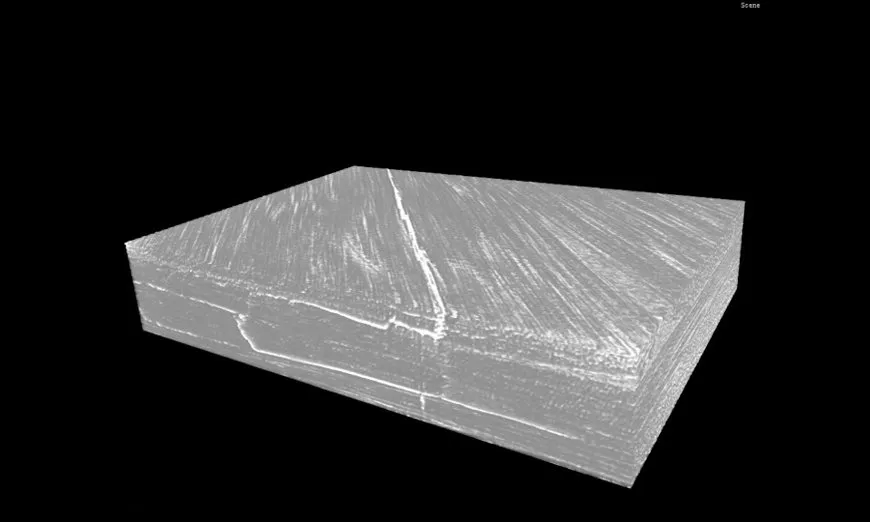
BliXray is offering its BLCT-LINACLAB high-energy CT system to the airframe and composite-aerostructure plants now coming on stream across the West, scanning long, bonded structures in one piece rather than as coupons cut from them.
The system combines scan volumes of up to ø720 × 2600 mm with helical, offset and segmented scan modes, so a complete aerostructure section passes through a single machine. The manipulator carries the part through the beam on a defined path, and the reconstruction returns one volume for the whole component rather than a set of local views.
Sized for the whole part
Standard CT cabinets top out well below a metre of scan height, and a wing or empennage section several metres long falls outside their working volume. The BLCT-LINACLAB is built around parts up to 2700 × 1400 mm on its manipulator and a six-axis motion system with a focus–detector distance of up to 4000 mm, so height stops being the limiting factor. Segmented and offset modes extend coverage further, allowing a tall or wide structure to be reconstructed as a single volume rather than a set of disconnected views.
The point is coverage: one set-up, one reconstructed part, one record. A defect that would sit between two local scans, or in a region that never reached a cabinet, is recorded in the same volume as everything else, and the result is filed against the serial number. An NDT department gains a whole-part inspection on a defined path, every time, in place of stitched local scans, bespoke fixtures or destructive sampling of parts that are expensive to make and slow to replace.
Helical, offset and segmented modes in one machine
Different modes trade reach against detail. An operator opens the field of view for a full-length pass and then concentrates resolution on a joint or fitting that warrants it, without moving the part to a second instrument.
- Helical scan: a continuous pass along the length of a long part, reconstructed as one volume.
- Offset scan: an extended field of view for wide sections.
- Segmented scan: coverage of a tall structure in one reconstruction rather than a set of disconnected views.
- Fan-beam mode with the collimated line detector: ø1250 × 2300 mm for the widest, densest sections.
“The BLCT-LINACLAB gives one volumetric picture of a part that will never fit inside a conventional cabinet,” says Adrian de Riz, Managing Director, BliXray Technologies GmbH. “A plant sees its own parts reconstructed in a test scan before committing to an installation.”
Dense fittings and bonded joints read in place
Composite laminates are low in density, and at accelerator energies their internal contrast is limited; high-energy CT is not the instrument for fine, ply-level porosity in bare laminate. The BLCT-LINACLAB earns its place on aerostructures elsewhere: in the metallic fittings, fasteners and bonded joints embedded in those structures, in dense sub-assemblies, and in capturing the true geometry and alignment of the whole part. Used this way it complements the lower-energy 2D X-ray and CT methods that resolve fine laminate detail, rather than competing with them.
That division of labour suits a structure that combines light composite skins with dense metallic load paths. The BLCT-LINACLAB reads the dense and bonded elements in place, without sectioning, and closes a gap in the inspection chain for aerospace and defence work on such structures.
Suited to wing sections, panels and bonded assemblies
The BLCT-LINACLAB is particularly suitable for large composite and bonded aerostructures: wing and empennage sections, fuselage panels, and the structures of light aircraft and advanced air mobility platforms. These parts are frequently several metres long yet comparatively light, and the system scans each of them whole, on a defined path, with the metallic fittings and bonded joints captured in the same volume as the overall geometry.
Test scans available
BliXray offers test scans of customer parts and site-planning support for large-part installations. Contact Adrian de Riz, Managing Director, BliXray Technologies GmbH, a.deriz@blix-ray.de, +49 1578 0477753 – www.blix-ray.de.
About BliXray – BliXray Technologies GmbH, Hannover, designs and builds industrial CT systems and X-ray safety cabinets. Manufacturers in defence, aerospace and research use BliXray CT to inspect safety-critical parts without destroying them. BliXray cabinets and containers house X-ray sources up to 300 kV at a protection level of 0.5 µSv/h.