Cookies and analytics.
We use analytics tools to see which pages are read and which companies visit this website. They set cookies only if you agree. The website works without them. Details in our privacy policy.

Defence CT
BliXray CT systems inspect layered armour panels and composite structures layer by layer. Delamination, disbonds and cracks in ceramic tiles become visible without damaging the panel.
Book a test scan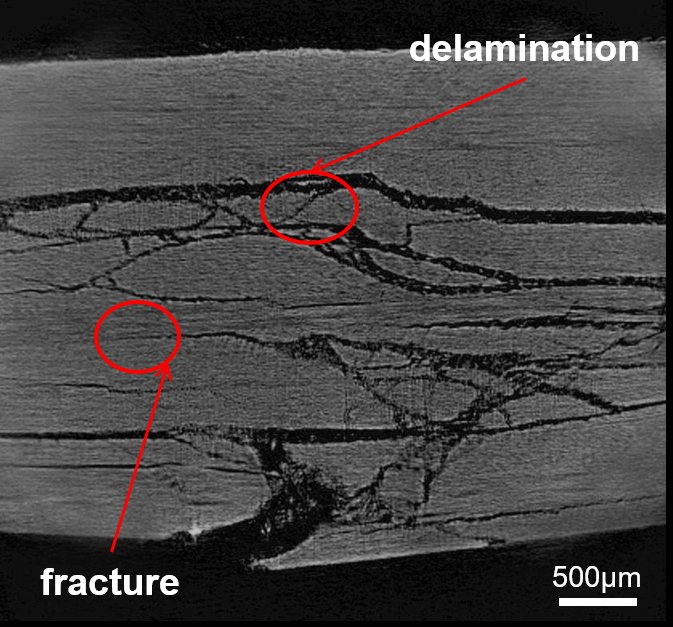
Armour panels and composite structures combine materials of very different density: ceramics, fibre laminates, metals and adhesives. The critical defects lie at the interfaces – a disbond between tile and backing or a delamination inside a laminate. Ultrasound finds many of them but struggles with thick, mixed stacks; CT shows every interface in the same volume.
Flat, wide panels suit a gantry system: BLCT-GALAB scans long and wide parts in a horizontal layout. Thick stacks with metal backing need the penetration of BLCT-HPLAB; for the densest structures BLCT-LINACLAB works with a linear accelerator.
For many panels CT complements it: ultrasound is fast on large areas, CT resolves thick, mixed stacks and shows the defect in 3D.
Yes, within the part size of the system. The gantry and high-power systems take parts up to 1010 × 1980 mm.
Yes. Defects are located by depth and interface, so each layer can be assessed separately.