Cookies and analytics.
We use analytics tools to see which pages are read and which companies visit this website. They set cookies only if you agree. The website works without them. Details in our privacy policy.

Defence CT
BliXray CT systems inspect structural castings and turbine blades from the first article to the production lot. Porosity, shrinkage, residual core and wall thickness are measured in one scan.
Book a test scan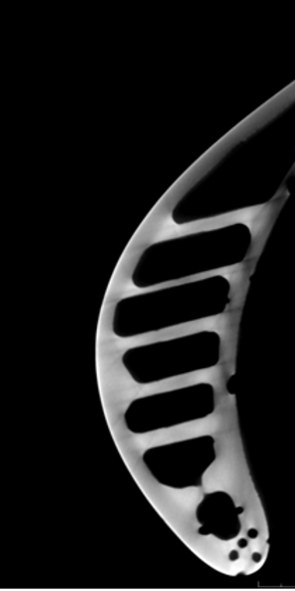
Castings for vehicles, aircraft and structures fail where the casting process left a flaw: gas porosity, shrinkage cavities, cold laps. Turbine blades add hollow geometry – residual ceramic core or a blocked cooling channel cannot be seen from outside. Radiography flattens these into one image; CT places each flaw in the part and measures the walls around it.
Turbine blades and smaller castings fit BLCT-MICROLAB. Large aluminium and steel castings need BLCT-HPLAB with sources up to 600 kV; for thick steel parts BLCT-LINACLAB penetrates up to 380 mm of steel with a linear accelerator.
Yes. The 3D volume shows every channel; residual core and narrowed sections are located and measured.
With the linear accelerator of BLCT-LINACLAB, up to 380 mm of steel.
Porosity is measured by size and position; the evaluation follows the acceptance criteria you specify.