
Application note ·
BliXray brings battery module CT inspection to complete modules and packs
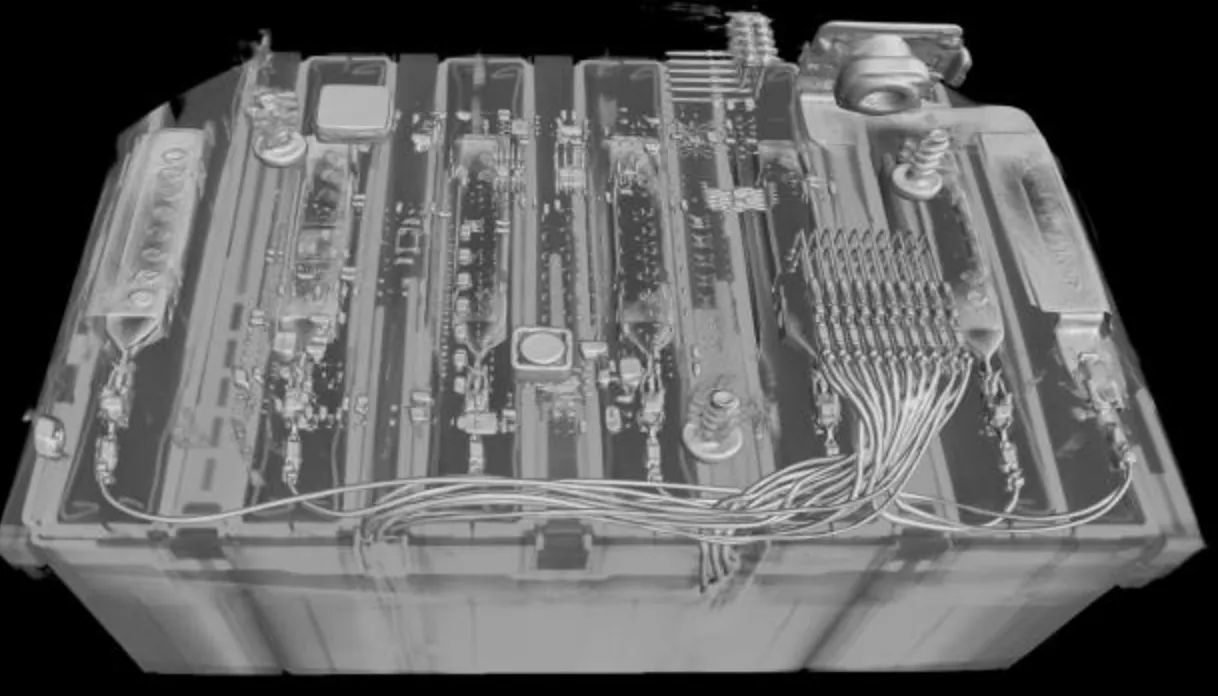
BliXray offers battery module CT inspection on the BLCT-GALAB, a horizontal computed tomography (CT) system that accepts complete battery modules and packs up to 1010 × 1980 mm and 300 kg. The system shows adhesive coverage, busbar joints and cell position inside the closed module, and the BLCT-HPLAB adds X-ray energies up to 600 kV for denser pack structures.
Once cells are bonded and the cover is closed, an adhesive gap, a displaced busbar or a tilted cell is no longer visible from outside. Teardown of sample modules destroys a high-value assembly and only ever checks a sample. BliXray applies CT to the assembled module instead and covers three inspection tasks in one scan:
- Adhesive coverage: the bonded area between cells and the cooling plate, evaluated cell by cell.
- Busbars, tabs and terminals: geometry, position and continuity of the electrical connections after assembly.
- Cell position and foreign objects: cell placement and spacing, and objects left in the module, including in the battery management area.
Adhesive coverage seen through the closed module
The BLCT-GALAB scans the module lying flat, in the same orientation it has on the assembly line. Slices through the adhesive layer between cells and cooling plate show where the bond is complete, displaced or missing. An automated evaluation reports the bonded area per cell and sorts each cell as OK or NG against an acceptance criterion that the customer defines. The same evaluation applies to glue surfaces in battery cooling units.
The module leaves the system intact, so it can go on to electrical testing or back to the line. “The BLCT-GALAB shows the adhesive layer, the busbars and every cell of a closed module in one scan, and the module leaves the system undamaged,” says Adrian de Riz, Managing Director, BliXray Technologies GmbH.
Busbars, connectors and cell position in one data set
Segmentation software separates the CT volume of a module into individually labelled components: cells, busbars, cooling channels, fasteners and housing. Each part can then be shown on its own and its position and alignment measured against the design. Misplaced screws or connectors, discontinuities at tabs, busbars and joints, structural misalignment and pinched or misrouted cabling appear in the same data set.
The same CT data confirms the geometry and position of the small safety-related hardware after assembly: rivets, terminals, tabs and plastic protection plates. Hidden misalignment, deformation and internal defects in these parts become visible without opening the module. The result is a part-by-part assembly check from a single scan, where a teardown would give one destroyed sample.
Horizontal CT sized for the whole module
A battery module is long, heavy and flat. The BLCT-GALAB keeps it lying and moves the X-ray source and detector around it, which avoids tall fixtures on a vertical rotary table. The system can be configured with X-ray voltages from 180 kV to 450 kV. A flat-panel detector with 74.8 µm pixels and 16-bit dynamic range gives a stated 2D resolution of 10 µm, enough to resolve adhesive gaps, joint geometry and cell-to-frame distance at module scale.
For long workpieces, a BLCT-GALAB configuration with two synchronised rotating gantries travels along the part and scans it end to end while it is held still. An optional six-axis robot loads and unloads parts through a dedicated port, so the same scan runs as a laboratory check on sampled modules or at-line beside the assembly line.
Where a pack sub-assembly is denser, the BLCT-HPLAB extends the energy range with a mini-focus X-ray source of up to 600 kV. It accepts parts up to ø1000 × 1500 mm and 100 kg, uses a 3072 × 3072 pixel flat-panel detector with 139 µm pixels, and keeps radiation leakage below 0.5 µSv/h.
“We size the system from four values: the largest part, the densest path through it, the smallest feature to be seen and the time available per part,” adds de Riz. “A test scan of a real module gives us those values before we propose a configuration.”
| Stated figure | BLCT-GALAB | BLCT-HPLAB |
|---|---|---|
| Maximum sample size | 1010 × 1980 mm | ø1000 × 1500 mm |
| Maximum sample weight | 300 kg | 100 kg |
| X-ray voltage | 180–450 kV | up to 600 kV (mini focus) |
| Detector | flat panel, 74.8 µm pixel, 16-bit | flat panel, 3072 × 3072 px, 139 µm pixel |
| 2D resolution | 10 µm | – |
| Radiation leakage | – | < 0.5 µSv/h |
Test scans available
BliXray offers CT testing of customer modules and packs on the BLCT-GALAB and BLCT-HPLAB. More battery applications are on the batteries page. Contact Adrian de Riz, Managing Director, BliXray Technologies GmbH, a.deriz@blix-ray.de, +49 511 57092696 – www.blix-ray.de.
About BliXray – BliXray Technologies GmbH, Hannover, designs and builds industrial CT systems and X-ray safety cabinets. Manufacturers in defence, aerospace and research use BliXray CT to inspect safety-critical parts without destroying them. BliXray cabinets and containers house X-ray sources up to 300 kV at a protection level of 0.5 µSv/h. CT for critical parts. Shielding for any source.