
News ·
BliXray offers high-voltage and MeV CT for large aerospace castings and welded structures
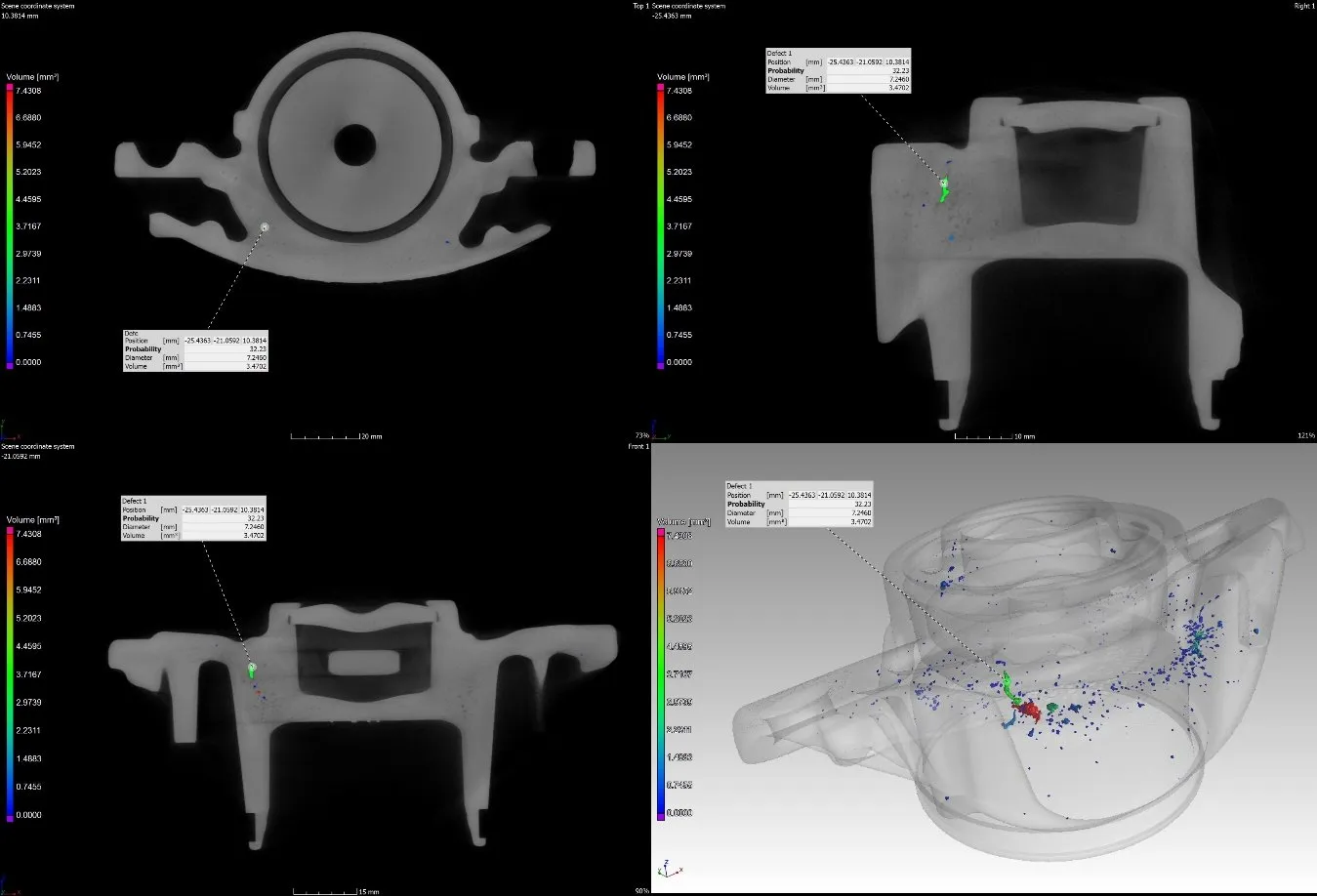
BliXray is offering two complementary CT systems – the high-voltage cabinet BLCT-HPLAB and the linear-accelerator BLCT-LINACLAB – to the launcher, engine and defence-vehicle plants across the West, scanning large castings, thick welded structures and turbine components that are too big or too dense for a standard inspection cabinet.
Both systems find porosity, shrinkage, cracks and weld defects inside the finished component rather than inferring them from a sectioned sample. The BLCT-HPLAB covers the large but penetrable majority of parts with high-voltage sources in a cabinet; the BLCT-LINACLAB takes the thickest and densest work with an electron linear accelerator. Together they deliver the volumetric picture that radiography alone rarely gives, for parts from die-cast housings up to complete motor cases.
High-voltage cabinet CT for large, heavy parts
The BLCT-HPLAB is a high-voltage cabinet CT for large, heavy parts. Its sources run from 190 to 450 kV, or from 225 to 600 kV with a mini-focus source in the larger configuration, and the cabinet takes parts up to 1010 × 1980 mm and 300 kg. A flat-panel detector and a line detector sit on the same seven-axis manipulator, with a focus–detector distance of 1500 mm and a magnification range from 1.3 to above 120, so a single cabinet moves from a general porosity survey to fine defect characterisation without changing machines. Measurement accuracy is stated as 4.5 + L/100 µm.
That range covers a large share of die-cast structures, gearbox and pump housings and comparable aerospace parts. For these components the BLCT-HPLAB closes the gap between a laboratory microfocus cabinet, which cannot penetrate them, and a full accelerator installation, which not every plant can house.
“Most inspection departments have a microfocus system for small parts and radiography for everything else. The BLCT-HPLAB gives them true volumetric CT for the large, dense parts that used to fall between the two,” says Adrian de Riz, Managing Director, BliXray Technologies GmbH.
Megavolt energies for the densest parts
Where even a high-voltage cabinet cannot see through the material, the BLCT-LINACLAB takes over. It uses an electron linear accelerator with 2, 4, 6 or 9 MeV in place of a conventional X-ray tube, penetrating up to 380 mm of steel and dense, multi-material assemblies that conventional sources cannot reach. That opens up large castings, thick welds, solid-propellant motors and fully assembled modules to complete volumetric inspection, in place of the destructive sectioning these parts would otherwise go through. Because the same physics limits every conventional CT system, penetration – not resolution – is usually the deciding factor for the heaviest aerospace and defence components, and the accelerator moves that limit.
Sized for the whole component
Both systems are built around the parts. The BLCT-LINACLAB accepts parts up to 2700 × 1400 mm on its manipulator and scans volumes of up to ø720 × 2600 mm, so complete motor cases, large structural castings and full assemblies are scanned in one piece instead of being cut into coupons. A focus–detector distance of up to 4000 mm on a granite or cast-iron base holds that geometry stable across the large distances involved, which matters when the same scan is used both for defect review and for dimensional comparison against the CAD model.
Key figures across the range
- BLCT-HPLAB sources: 190–450 kV, or 225–600 kV with a mini-focus source.
- BLCT-HPLAB parts: up to 1010 × 1980 mm and 300 kg; flat-panel and line detector; seven axes.
- BLCT-LINACLAB source: an electron linear accelerator with 2, 4, 6 and 9 MeV, for steel up to 380 mm.
- BLCT-LINACLAB parts: up to 2700 × 1400 mm on the manipulator; scan volume up to ø720 × 2600 mm.
- Shared software and workflow: one inspection approach across both systems.
One inspection approach from prototype to series
Because the two systems share the same software and inspection workflow, a plant matches the source to the part: the cabinet for the large but penetrable majority, the accelerator for the thickest and densest work. For a programme ramping from prototype to series production, one inspection approach follows a component through its full life without re-qualifying a new method at each step. The range suits large structural castings, thick welded structures, turbine components, gearbox and pump housings, solid-propellant motors and assembled modules; see castings and defence CT.
Test scans available
BliXray offers test scans of customer parts on both systems. Contact Adrian de Riz, Managing Director, BliXray Technologies GmbH, a.deriz@blix-ray.de, +49 1578 0477753 – www.blix-ray.de.
About BliXray – BliXray Technologies GmbH, Hannover, designs and builds industrial CT systems and X-ray safety cabinets. Manufacturers in defence, aerospace and research use BliXray CT to inspect safety-critical parts without destroying them. BliXray cabinets and containers house X-ray sources up to 300 kV at a protection level of 0.5 µSv/h.